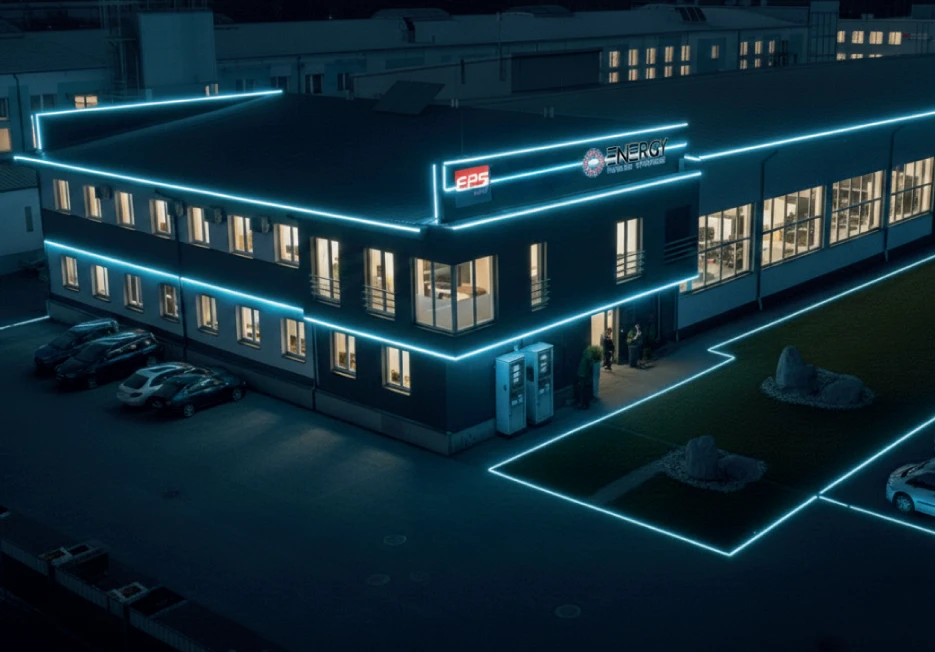
Commercial real estate
An office building or shopping centre works only as well as its infrastructure. Backup power keeps lifts, ventilation and safety systems running — and guarantees tenants business continuity.
Dependable power for building systems: lifts, ventilation, safety and tenant infrastructure.
65 dB(A)
noise level of the acoustic enclosure
N+1
redundant configurations available
8 h
autonomy on the base fuel tank
Sector challenges
Safety systems
Lifts, emergency lighting, fire pumps and smoke extraction must work independently of the grid.
Tenant agreements
Infrastructure downtime means contractual penalties and damage to a class A property's reputation.
Limited space
Plant rooms and rooftops demand compact, quiet enclosures that meet the neighbourhood's acoustic requirements.
What we deliver
- Generator sets in soundproofed enclosures — containerised and indoor — matched to the building's architecture.
- ATS automation with prioritisation of the building's critical loads.
- UPS systems for building server rooms and BMS installations.
- Service work at night — without disturbing tenants.
Where we work
Typical facilities for which we size and service power systems in this sector.
What an outage costs
Before we calculate the power, we calculate the consequences of losing it. They decide the system architecture.
Lifts out of service
Evacuation and lift availability are the first sign of a failure that tenants and visitors notice.
Safety systems
Smoke extraction, fire pumps and emergency lighting must work independently of the grid — a requirement, not an option.
The building's reputation
Infrastructure downtime translates into contractual penalties and a weaker position when leases come up for renewal.
How we work
Audit and sizing
We analyse the load profile, inrush currents and the facility's formal requirements.
Design and delivery
Our own design office engineers the system; production builds the equipment for your project.
Installation and commissioning
Installation, ATS integration, load testing and operator training.
Service and care
Periodic inspections and support throughout the system's entire service life.
Standards and requirements
Systems are designed around fire-safety requirements for equipment that must operate during a fire, and around environmental noise limits — acoustic enclosures and silencers are selected so the property meets permissible levels at the site boundary, including at night. Electrical installations follow PN-HD 60364.
Frequently asked questions
Where should the generator go in an existing building?
Usually in a basement plant room or in an outdoor enclosure on site. Three things decide it: cooling air supply, exhaust routed above the roof, and noise attenuation. We verify all three for every candidate location before proposing a solution.
Will one generator cover the whole building?
It does not have to. It is usually better to back up selected loads: lifts, safety systems, the server room and part of the building services. Transfer automation sheds non-essential loads, which keeps both the generator size and the investment reasonable.
What does service look like in an occupied building?
Inspections are scheduled at night or at weekends, agreed with the property manager. Noisy work and on-load testing take place outside tenants' working hours.
Let's talk about powering your facility
Tell us about your site — we'll match the power, technology and system architecture, then prepare a quote.